“Filling the gap:” How The Health Hut combines funding to meet patients where they are
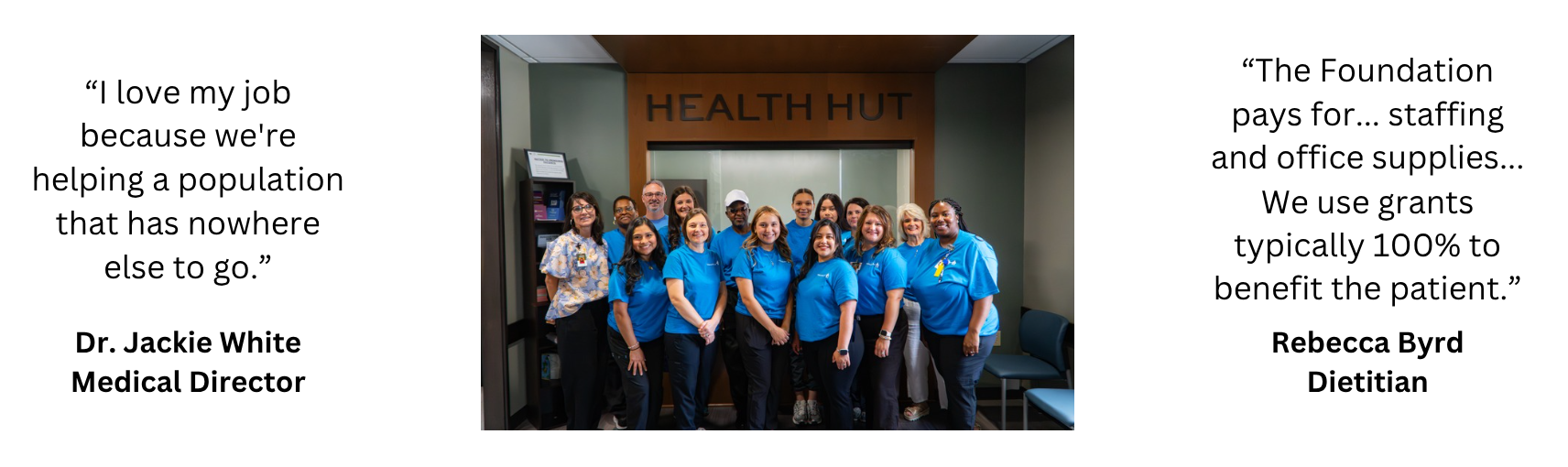
Rural health is a hot topic right now in the grant world! That’s why I was so excited to talk with leaders from a local health nonprofit serving residents in my rural area. The Health Hut has an intriguing history and a strong mission, and I couldn’t wait to hear more.
Welcome to our conversation.
First of all, can you both introduce yourselves?
JW: I'm Dr. Jackie White, and I'm the Medical Director here at The Health Hut.
RB: And I'm Rebecca Byrd, the Dietitian and Assistant Grant Writer.
Then to set context, can you tell me about The Health Hut and where you're located?
JW: The Health Hut is a free clinic for people in Lincoln Parish, Louisiana. It is mainly funded by the Lincoln Health Foundation and started in 2012 to fill the gap for people who did not have insurance and did not have anywhere to go. I came here in 2015; and in 2017, we went from seeing just uninsured patients to people who did have Medicaid. Back in 2017, we didn't have enough Medicaid providers in our parish, so our Board let us take Medicaid patients, just so those people would have a provider. About 70% of our patients right now are uninsured, and anywhere from 25-35% are on Medicaid.
We try to follow a health needs assessment that the Foundation does every couple years. We used to see only adults because that was the need. Recently pediatrics has become a need; so two or three years ago, our Board allowed us to start seeing kids because there were more and more uninsured children.
Finally, we do primary care. We try to encourage our patients to call and make an appointment; but we do have walk-ins and try to fit them in too. Our patient schedules can be undetermined, or they work hourly and don't want to miss their jobs.
Why do you do what you do, personally and/or as an organization?
RB: I started working at the Health Hut almost 7 years ago, and I never thought I would do counseling as a job. It never appealed to me before, but I really like the monthly interaction that I get just because it's a free clinic. Patients can come as often as they want; they don't have to pay for it. And so a lot of them come pretty regularly - monthly, every two months, every three months. I really just enjoy getting to know the person - why they're doing what they're doing, why they're struggling, and how we can help fix the struggle. A lot of times people just need somebody to give them some ideas, and so I enjoy that. I really enjoy the relationship side of it.
JW: I love my job because we're helping a population that has nowhere else to go. And we're able to really take care of them as a whole patient. We do primary care, so there are some things we're not able to answer for them, but I think it's serving a huge benefit. I saw it from the outside when I worked at the ER. These patients had nowhere to go; they'd go get one ER visit, and then they're never able to financially come out.
And you know what? It's funny to me, because we're able to tell patients what they need to hear, rather than worrying about if they come back or not. We can do what's best for them and not necessarily what they want. That's a hard thing to do in primary care.
I think everybody that works here enjoys it. There are other options out there if it's not your thing. We all have gifts that we love to do. We have a lot of students come through here - people working on their Master’s or projects. And that's what we tell them. If this is not your passion or love, we'll help you find it somewhere else. At least it shows you what's out there. And when you have a patient or you have a friend or family member, you know where to send them.
I love that background. Ok, so now switching to grants. What role do grants play in your organization?
RB: Well the Foundation pays for things like staffing and office supplies, all the day-to-day running. We use grants typically 100% to benefit the patient. Occasionally, we've bought, medical equipment, but a lot of the grants that we've gotten have been to buy food and some of the healthier items to pass out as samples, to just show our patients some options. We have also used grants to try out something new. Like we need another translator part-time, but the money's not budgeted for this year. Can we get a grant to pay for it?
JW: Right, our first grant for additional staff was for a translator. We now have three full-time translators, and we're about to look for another one at least part-time. We have two providers a day, so between those and our counselor and our dietitian, our translators are busy. And now we even put a translator at the front desk because patients are calling to schedule, and we need someone to help us with the phone calls. Last year, annually, our patients were 45% Hispanic; this past quarter, it was 49%. And Spanish is the primary language for over 95% of those patients. So our ability to serve them has really grown.
Another example is Rebecca was actually started with a grant for a dietitian because we had so many diabetic patients and people that had hypertension, overweight, and just needed a little extra time with someone. So, through a grant from Living Well, we got a dietitian. That grant was for a year. It was so amazing, and our patients benefited so much that our Board allowed us to hire Rebecca on. And then we expanded her time through a grant. Then after that grant was done, the Board told us we could hire her; so she's now two and a half days a week. Same thing with counseling - when I came on, we had a counselor. But we've expanded counseling services, too, just to try to help our patients because of the needs.
What does the grant process look like in your organization? What roles do you each play?
JW: When I first came on, I was just the Medical Director, not doing grants. But then we lost our Administrator for a while, so I finished out the grants we had going.
And I need to give kudos to Rebecca. I was doing all the grants here when Rebecca came along. I started asking her, “Hey, will you help me with this? Can you read through that? What do you think of this?” And she's been amazing.
Chelsea, our Administrator, helps too. She does our United Way grant now. And Chelsea does most of our Foundation quarterly report; I'll just add to it. The Foundation loves statistics!
Ok thanks for sharing. Can you give me more examples of grants you’ve received and what they funded?
JW: Yes, we’ve gotten:
A mental health grant from Louisiana Healthcare Connections (a Medicaid company). It was $25,000, which funded education, office furniture, materials and books to give to patients.
A $25,000 grant from United Healthcare
A Susan G Komen Foundation grant with LSU for our mammogram bus
A $2,500 Wal-Mart grant
A $5,000 Willis-Knighton grant
A $10,000 Claiborne Electric grant, which funded our phone system
RB: I’ll add that the grant for the phone system allowed us to put funds in places where we could benefit patients more. So Claiborne Electric wasn't going to give us money to buy food or supplies. But, because we didn't need to use our funding on phones, we were able to do more food and supplies instead.
How do you find grants?
JW: There were a bunch of super easy grants around COVID. Rebecca really did Google grants. Once again, thanks to the Lincoln Health Foundation, we can devote most of our time to clinical care, but we will look for additional grants that may benefit our patients.
And we are a member of the National Association of Free & Charitable Clinics (NAFC). That is where 90% of our other grants have come from. Being a member has already vetted us so that most of our bigger grants, and a lot of those COVID grants, were communicated to us through NAFC.
Through COVID, there were tons of grants. Now grants are more selective. And I think because most of our money comes from the Foundation, and we're not totally dependent on a grant for our employees, we don't get a lot of them. But I can easily filter through the grants, and they're easy to apply for and do.
How do you choose whether to pursue a grant or not? Is there a minimum dollar amount that’s not worth pursuing?
JW: We do them for $500!
RB: Yeah. Anything we can get.
JW: Here's the thing, we can always put funding into our little food pantry. We do gift cards; it’s super nice to have $25 gift cards. Whether it's for food, gas, or medicine, our patients can go to Walgreens or Walmart with these gift cards. So yeah, nothing's too small for us.
To be honest, Alicia, the first thing I look at in a grant is the application. If it's more than a couple pages, or even 5 or 10, it may not be worth the time. There was even one we did once, and I'd rather give the money than have to do a grant with that agency again. You know what I'm saying? Maybe it's because we don't have anybody to write them other than us.
RB: Yes, everybody's getting paid for our time. We have to look at the time invested, and how much time it’s going to take to fill out an application.
JW: We also look at the reporting required if we are awarded the grant. We get accountability, so we love that the Foundation wants a quarterly report because we can utilize that usually in a lot of our grants.
We had one grant before COVID for a free in-house lab. It was great, but we had to keep up with the results of every test we did. It was huge and laborious. We just didn't have the staff, and it was very labor-intensive to track detailed results given. So that's a big thing we look at.
All right, I want to talk more about how you successfully worked with a ULM Master’s student in Public Administration who was taking a grant writing course. That is a model that I really like and have seen work for different people, and I want to keep sharing it.
JW: Yeah, that was a big one.
RB: We both met with him. The grant required two companies that would supply what we needed. And then, if we chose the more expensive one, we had to give reasons about why we did that. So the student did a lot of homework and found out all kinds of stuff. I know nothing about a phone system! I was like, this is great, because it would have taken me forever to talk to all these people and find out all this information. And then after he finished the application, we had to tweak it because the phone system changed a little bit. But I was able to call his contacts and get more information and a different quote. That would have taken me forever, had I started from scratch. Without him, we wouldn't have done the grant.
Awesome. Anything else you would share as we close?
RB: We probably look at grants differently because we aren't supporting the office with grants. We’re looking for the most efficient way to get the most money to provide what our patients need. Intangible items, typically.
JW: We’re really fortunate that we're not having to constantly worry from year to year. Is this position going to be here or not? We really have a good cushion to fall back on with the Health Foundation. We're very fortunate.
RB: It's been great, because most of our patients are food insecure, so we partner with the food bank. And we're not as limited to their normal parameters because we are a medical clinic. We can give out food boxes. And we've had a lot of monetary donations here lately, so we can buy things that supplement that box or make another box with healthier items. And sometimes I buy things that I know people wouldn't buy, things more expensive than what they would spend, but it's a treat. And then the gift cards are great for transportation needs, medicine needs. And so almost everything we buy with grants we're giving away to the patient. We're probably not normal in that respect. Different than other nonprofits.